
Yin Yang vs Five Elements: What Is the Difference?
Two frames from the same Chinese seasonal tradition — one describes the shape of a moment, the other describes the direction of a process. Here is a plain-English comparison for Western readers, written for someone with no prior background needed.
What Yin-Yang actually is
Yin-Yang (阴阳, Yīnyáng) is the oldest and most general frame in the Chinese seasonal tradition. It says that every quality has its opposite, and that the two are not in conflict — they are mutually arising, each containing the seed of the other. Yin is the cool, the still, the inward, the moist, the night. Yang is the warm, the active, the outward, the dry, the day. Nothing is purely one or the other; every moment carries both, in different proportions.
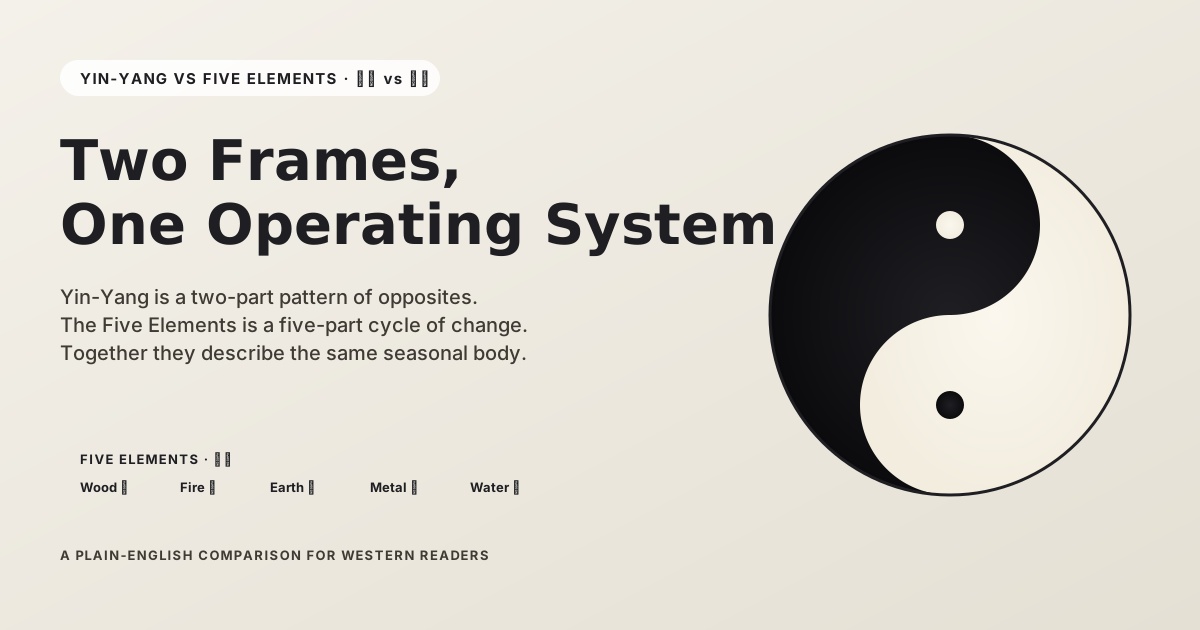
The familiar black-and-white taijitu symbol captures three ideas at once: that opposites are paired (the white and the dark), that they flow into each other (the curved S-shape), and that each contains the seed of its counterpart (the small dot of the opposite color inside each half). For a deeper background, the Wikipedia overview of Yin and Yang walks through the historical and philosophical layers. None of this is a clinical claim — it is a cultural and philosophical lens that has been used in food, design, medicine, martial arts, and seasonal living for more than two thousand years.
What the Five Elements actually are
The Five Elements (五行, Wǔxíng) — sometimes translated as Five Phases — is a five-part cycle of change. The five are Wood (木, mù), Fire (火, huǒ), Earth (土, tǔ), Metal (金, jīn), and Water (水, shuǐ). They are read as five stages of a process, not as five literal substances. Each gives rise to the next in a continuous cycle: Wood feeds Fire, Fire creates Earth (as ash), Earth carries Metal, Metal collects Water, Water nourishes Wood. The cycle also has a controlling sequence — Wood parts Earth, Earth absorbs Water, Water quenches Fire, Fire melts Metal, Metal cuts Wood — used to describe balance between phases.
In seasonal wellness writing, each element is associated with a season, an emotion, a pair of organs, a color, and a flavor. Wood is spring, anger, the liver and gallbladder, green, and sour. Fire is summer, joy, the heart and small intestine, red, and bitter. Earth is late summer, worry, the spleen and stomach, yellow, and sweet. Metal is autumn, grief, the lungs and large intestine, white, and pungent. Water is winter, fear, the kidneys and bladder, black, and salty. The Five Elements explained guide on this site walks through the same map with more room. For an external reference, the Wikipedia overview of Wu Xing covers the historical and linguistic layers in more depth.
The difference in one line
Yin-Yang describes the shape of a moment. The Five Elements describe the direction of a process. The first answers the question "what does this feel like right now?" The second answers "where is this heading next?" A summer afternoon at the Summer Solstice, read through both lenses, is Yang within Yang (peak brightness, peak warmth, peak outward energy) and Fire at its peak in the Five Elements cycle. The two readings agree, and they describe different aspects of the same afternoon.
- Yin-Yang is a two-part pattern of opposites.
- The Five Elements is a five-part cycle of phases.
- Yin-Yang is the better frame for describing balance within a moment.
- The Five Elements is the better frame for describing change over time.
- Both are cultural and educational reading tools, not medical prescriptions.
How Yin-Yang shows up in seasonal living
Yin-Yang is most often used in this site's seasonal articles to mark the year's turning points. The Winter Solstice (冬至, Dōngzhì) is read as the year's peak Yin — the longest night, the deepest stillness — and the moment the first Yang is said to be born. The Summer Solstice (夏至, Xiàzhì) is the mirror image: peak Yang for the year, and the moment the first Yin begins. The 24 solar terms are a more detailed rhythm layered on top of this two-part pattern; you can see the whole year in our complete 24-term guide.
Yin-Yang also shows up at the daily scale. Morning is Yang rising (light, activity, outward focus). Midday is Yang at its peak. Evening is Yin rising (dim light, slower pace, inward focus). Midnight is Yin at its peak. This is the same two-part pattern rotated through a 24-hour cycle, and it is the cultural background to the Chinese body clock idea — that different hours of the day are read as carrying different qualities of energy.
How the Five Elements show up in seasonal living
The Five Elements are most often used to describe the seasons, the emotions, the organs, and the food on the plate. Wood is the green of spring, the sour taste of a few drops of lemon in warm water, the gentle stretch of a morning walk, the emotion of patience rather than frustration. Fire is the red of summer, the bitter taste of dark leafy greens, the joy of a meal with friends, the lightness of an afternoon rest. Earth is the yellow of late summer, the sweet taste of a ripe pear, the worry that comes with overthinking, the comfort of a simple bowl of congee. Metal is the white of autumn, the pungent taste of ginger or pear, the clean cool air after rain, the small grief of letting go. Water is the black of winter, the salty taste of a slow-cooked broth, the stillness of an evening by the fire, the fear that asks for rest rather than push.
The Five Elements are the cultural background to most of SeasonQi's content: the Element Compass tool, the Chinese zodiac and elements guide, the autumn Metal element article, the winter Water element article, and the seasonal eating beginner map. None of this is a clinical protocol. It is a cultural lens for choosing food, rest, and movement that match the season you are in.
Where the two frames overlap
Yin-Yang and the Five Elements are not in competition. They overlap in several places. Each element has a Yin and a Yang quality — Wood has Yin Wood (a softer, more inward spring) and Yang Wood (a brighter, more outward spring). Fire has Yin Fire (the warmth of a held hand) and Yang Fire (the brightness of noon). Metal has Yin Metal (the quiet of a held breath) and Yang Metal (the crispness of an autumn morning). This overlap is where the two frames meet: Yin-Yang names the balance within the moment, the Five Elements name the phase of change the moment belongs to.
This overlap is also why some practitioners start with one frame and add the other later. The Element Compass on this site leans more on the Five Elements, because elements are easier to map to specific seasons, flavors, and emotions. The Yin and Yang balance beginner guide leans more on Yin-Yang, because opposites are easier to map onto daily and weekly rhythms. Both articles are short and start from zero. They are designed to be read in either order.
A simple worked example: the Summer Solstice afternoon
Take one moment — a summer afternoon in late June, around the Summer Solstice. Read it through Yin-Yang first.
- The sun is high, the day is long, the air is warm. The reading is peak Yang within a generally Yang season.
- But there is also shade under a tree, a glass of room-temperature water, a moment of quiet after lunch. The reading is Yin being born inside Yang — the slow turn back toward the cooling side of the year.
- The cultural habit is to support that small Yin: a short afternoon rest, a cool-water rinse, an evening walk in fading light. None of this is a clinical prescription.
Now read the same afternoon through the Five Elements.
- The season is summer, the element is Fire (火), the associated organs are the heart and small intestine.
- The Fire element's emotion is joy, and the late-June social calendar often lives up to that — long meals, late conversations, a sense of plenty.
- The Fire element's flavor is bitter, which is why bitter greens (dandelion, arugula, endive) and slightly bitter teas (green tea, chrysanthemum) recur in summer food writing.
- The Fire element's color is red, which is why red foods — watermelon, tomato, strawberry — are read as seasonal in midsummer.
The two readings agree, and they describe different aspects of the same afternoon. Yin-Yang names the balance within the moment. The Five Elements name the season the moment belongs to. Read together, they give a fuller picture than either alone. The Summer Solstice wellness guide on this site is a worked example of how the two frames are layered in practice.
Common confusions between the two frames
Three confusions come up often when Western readers first encounter these two frames.
- "Yin-Yang is a philosophy, the Five Elements is a wellness tool." Both are used in both directions. Yin-Yang appears in food, design, and seasonal planning as well as philosophy. The Five Elements appear in classical philosophy and cosmology as well as wellness writing. The split between "philosophy" and "wellness" is a modern simplification, not a hard line in the source material.
- "The Five Elements are like the four Western elements." The Western classical elements (earth, water, air, fire) are read as substances the world is made of. The Chinese Five Elements are read as phases of change, not substances. Wood is not a substance, it is a phase — the phase of growth, of spring, of the upward push of green. Water is not a substance, it is the phase of rest, of winter, of the downward pull of stillness. For a deeper look, the Wikipedia overview of the Five Phases traces the difference.
- "Yin is bad and Yang is good." This is the most common inversion of the frame. Neither Yin nor Yang is good or bad. They are paired qualities, each needed for the other to be visible. A summer afternoon that was all Yang would be exhausting; a winter morning that was all Yin would be paralyzing. The cultural habit is to notice which quality is loudest in the moment and to support the smaller one. For a closer read of this balance in modern life, the Yin and Yang balance article is a short walk-through.
Which frame to start with
If you only have time for one, start with the Five Elements. The five-phase cycle is easier to map onto seasons, food, emotions, and organs, and it recurs across most of SeasonQi's beginner content. Once the five are familiar, layer in Yin-Yang to read the balance within each season. The two frames together describe the same seasonal body from two angles.
For a longer historical background on how the two frames sit inside the broader Chinese philosophical tradition, the Wikipedia overview of Chinese philosophy is a good general entry point, and the Wikipedia overview of Daoism traces the philosophical stream that runs alongside both frames. None of this is a clinical or medical claim. The two frames are cultural and educational reading tools, drawn from a long Chinese tradition.
What this article is not
It is not a treatment for any medical condition. It is not a clinical protocol, a prescription, or a substitute for a qualified healthcare professional. Yin-Yang, the Five Elements, and the seasonal language used here are cultural and educational, drawn from the Chinese seasonal wellness tradition. If you have a known health condition, are pregnant, take medication, or have any other concern, please consult a qualified clinician before changing food, exercise, or sleep patterns in the name of seasonal balance — or on any other day.
SeasonQi ritual prompt
Pick one moment this week — a meal, a short walk, a quiet evening — and read it first through Yin-Yang (what is the shape of this moment?) and then through the Five Elements (which phase of the season is this?). Notice what each lens shows you that the other does not. The point is not to label everything; it is to notice that two simple frames give a fuller picture than one.
Safety and scope
This article is for educational and cultural purposes only. It is not medical advice, diagnosis, or treatment. It is not a substitute for a qualified healthcare professional. If you have a known health condition, are pregnant, take medication, or have any other concern, please consult a licensed clinician before changing food, movement, or sleep patterns.